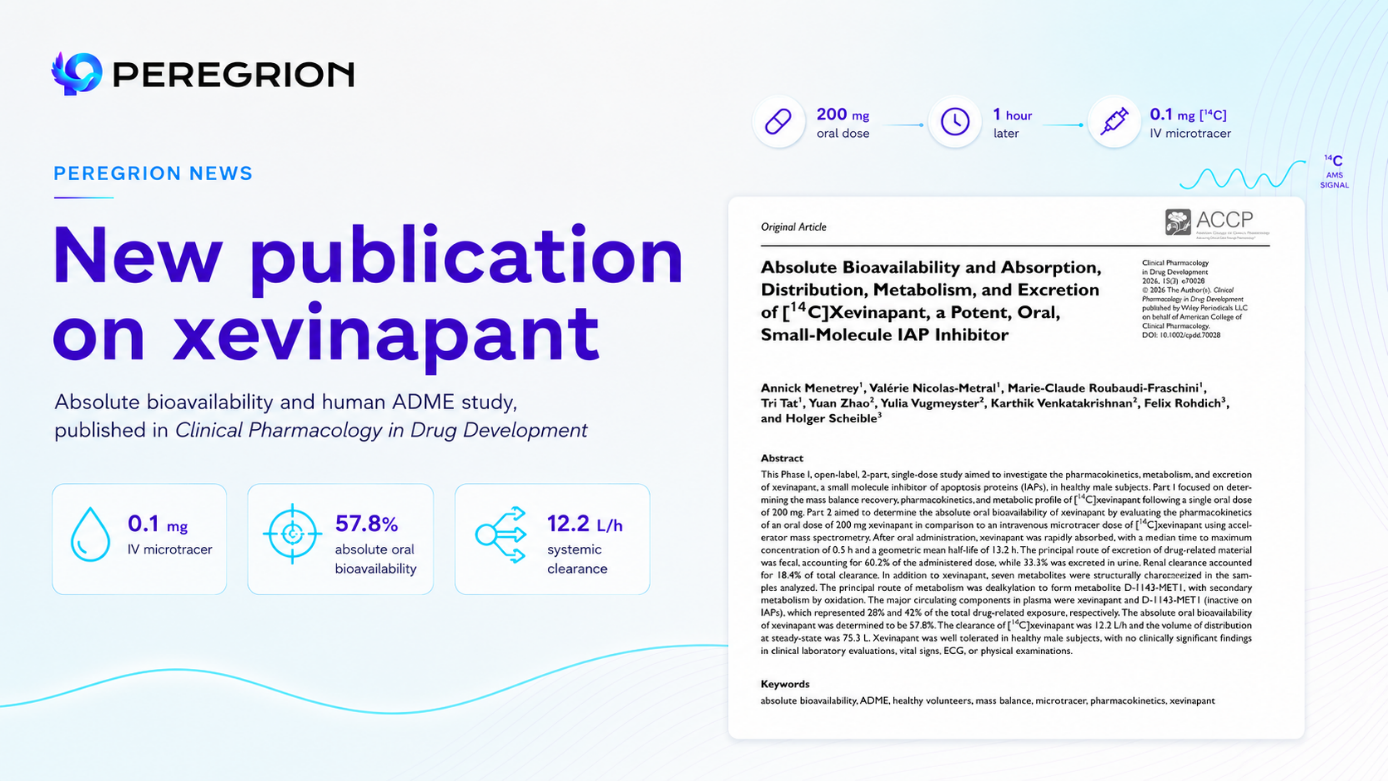
A Phase 1 study on the absolute bioavailability, pharmacokinetics, metabolism and excretion of xevinapant has been published open access in Clinical Pharmacology in Drug Development.
The study consisted of two parts. In the first part, participants received a single 200 mg oral dose of [¹⁴C]xevinapant to characterise mass balance and the human metabolite profile. In the second part, a 200 mg oral dose of xevinapant was followed one hour later by a 0.1 mg intravenous [¹⁴C]xevinapant microtracer.
For the intravenous microtracer part, the team now operating as Peregrion, then part of TNO, generated the accelerator mass spectrometry data. The analysis included total radioactivity in plasma, urine and feces, together with the quantification of [¹⁴C]xevinapant and its major metabolite [¹⁴C]D-1143-MET1 in plasma.
The IV microtracer provided the direct reference required to determine an absolute oral bioavailability of 57.8%. The data also enabled direct estimates of systemic clearance of 12.2 L/h and a volume of distribution at steady state of 75.3 L. In the oral radiolabel part of the study, 93.5% of the administered radioactivity was recovered, with 60.2% recovered in feces and 33.3% in urine.
This publication demonstrates how an AMS-enabled intravenous microtracer can add absolute bioavailability, clearance and distribution data to generate an even more complete mass balance model of drug disposition.
Read the full open-access publication:
Menetrey A, Nicolas-Metral V, Roubaudi-Fraschini M-C, et al. Absolute Bioavailability and Absorption, Distribution, Metabolism, and Excretion of [¹⁴C]Xevinapant, a Potent, Oral, Small-Molecule IAP Inhibitor. Clinical Pharmacology in Drug Development. 2026;15(3):e70028. DOI: 10.1002/cpdd.70028.