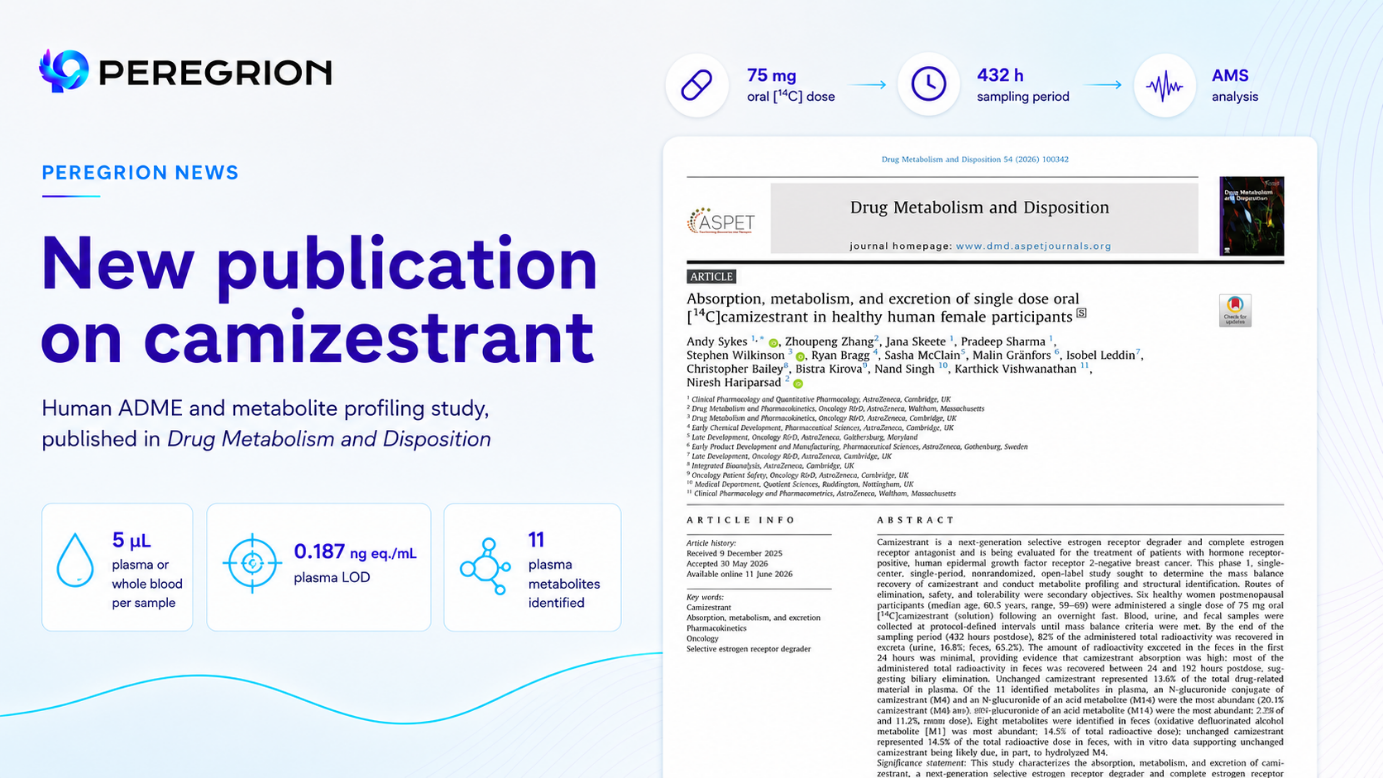
A new open-access Phase 1 study describing the absorption, metabolism, excretion, and circulating metabolite profile of camizestrant has been published in Drug Metabolism and Disposition.
Camizestrant is a next-generation oral selective estrogen receptor degrader and complete estrogen receptor antagonist under development by AstraZeneca for hormone receptor-positive, HER2-negative breast cancer. In the study, six healthy postmenopausal women received a single 75 mg oral dose of [¹⁴C]camizestrant containing up to 18 µCi of radioactivity.
The clinical study was conducted by Quotient Sciences on behalf of AstraZeneca. The team now operating as Peregrion, then part of TNO, measured total radioactivity in plasma and whole blood using accelerator mass spectrometry. The team also performed metabolite profiling and structural identification in pooled plasma, urine, and fecal samples using chromatographic separation, high-resolution mass spectrometry, fraction collection, and subsequent AMS analysis.
For the total-radioactivity analysis, only 5 µL of plasma or whole blood was required per sample. The lower limit of detection was 0.187 ng equivalents/mL in plasma and 0.655 ng equivalents/mL in whole blood.
The AMS sensitivity supported the characterisation of the 0–72-hour pooled plasma profile, in which unchanged camizestrant accounted for 13.6% of the radioactivity represented in the profile. Eleven metabolites were identified in plasma. The most abundant was M4, an N-glucuronide conjugate of camizestrant, which accounted for 20.1% of the pooled plasma profile. M14, an N-glucuronide of an acid metabolite, was estimated to account for 11.2%. Thirteen metabolites were identified in urine and eight in feces.
By the end of the 432-hour sampling period, 82% of the administered radioactivity had been recovered, with 65.2% recovered in feces and 16.8% in urine. Only a small amount of radioactivity was recovered in feces during the first 24 hours, while most fecal recovery occurred between 24 and 192 hours. This supported high absorption and suggested that biliary elimination was the main route of excretion.
This publication demonstrates how AMS can support human ADME and metabolite characterisation at low circulating ¹⁴C concentrations and on small sample volumes, while providing detailed insight into circulating and excreted drug-related material.
Read the full open-access publication:
Sykes A, Zhang Z, Skeete J, et al. Absorption, Metabolism, and Excretion of Single Dose Oral [¹⁴C]Camizestrant in Healthy Human Female Participants. Drug Metabolism and Disposition. 2026;54:100342. DOI: 10.1016/j.dmd.2026.100342