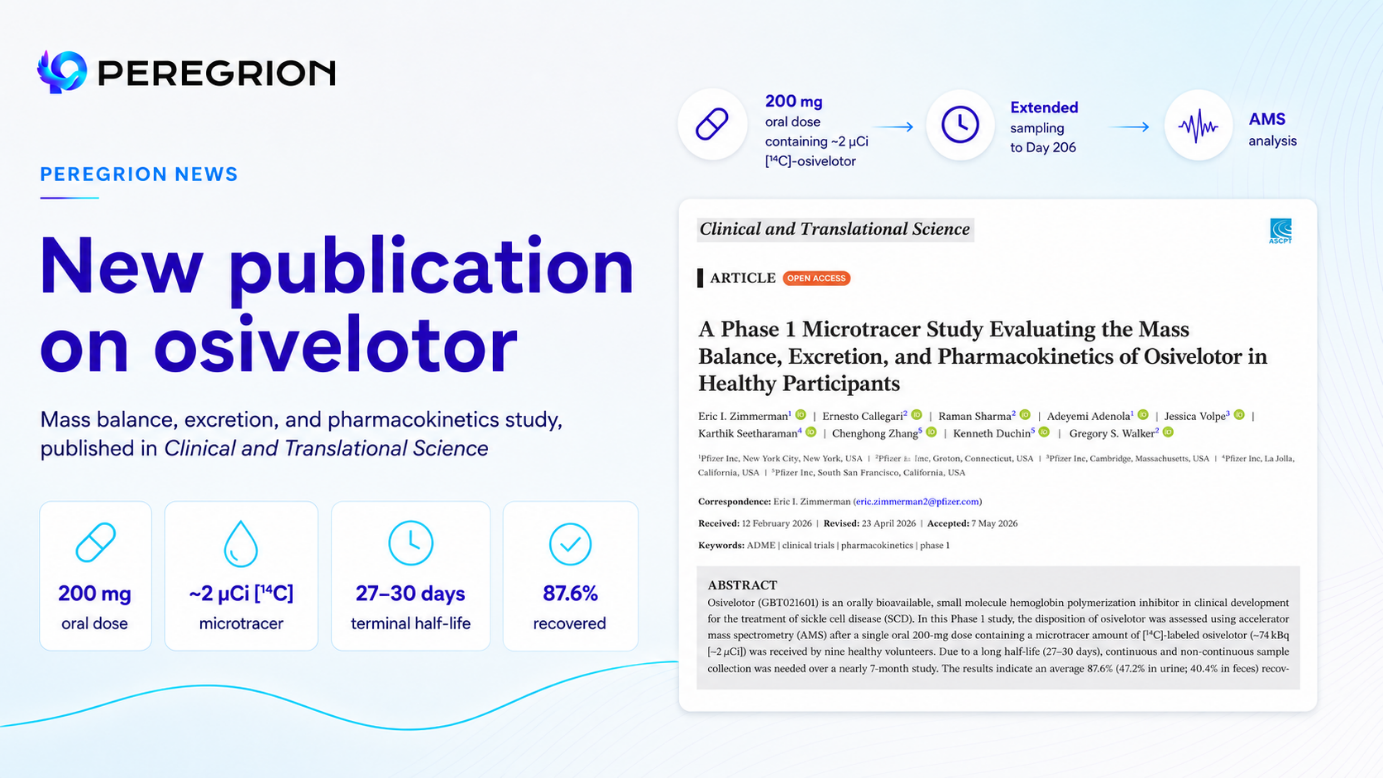
A new open-access Phase 1 study describing the mass balance, excretion, pharmacokinetics, and circulating metabolites of osivelotor has been published in Clinical and Translational Science.
Osivelotor is an orally available small-molecule hemoglobin polymerization inhibitor in clinical development for the treatment of sickle cell disease. In the study, nine healthy participants received a single 200 mg oral dose containing approximately 2 µCi of [¹⁴C]-labeled osivelotor.
Osivelotor has a long terminal half-life of approximately 27–30 days. To characterise its disposition while keeping the study practical for participants, the study combined an approximately one-month inpatient period with non-continuous outpatient sample collections extending to day 206.
The team now operating as Peregrion, then part of TNO, performed the accelerator mass spectrometry analyses. These covered total radioactivity in whole blood, plasma, urine, and feces. TNO also performed metabolite profiling and structural identification in whole blood and plasma using chromatographic separation, mass spectrometry, fraction collection, and subsequent AMS analysis.
The sensitivity of AMS enabled the use of a low radioactive dose and was leveraged to quantify small amounts of excreted [¹⁴C]-labeled osivelotor and its metabolites over the extended collection period, helping to establish mass balance. By the end of the study, an average of 87.6% of the administered radioactivity had been recovered, with 47.2% recovered in urine and 40.4% in feces.
Osivelotor remained the predominant circulating drug-related component. It accounted for 98.3% of radioactivity in whole blood, the pharmacological effect compartment, where no metabolites were detected above the identification threshold. In plasma, osivelotor represented 68.1% of circulating radioactivity. One major plasma metabolite, an aliphatic glucuronide, accounted for 19.7%.
This publication demonstrates how microtracer dosing, AMS sensitivity, and a combination of continuous and non-continuous sample collection can support human ADME studies for compounds with a long pharmacokinetic half-life, while balancing data capture with the practical and operational aspects of a prolonged Phase 1 study.
Read the full open-access publication:
Zimmerman EI, Callegari E, Sharma R, et al. A Phase 1 Microtracer Study Evaluating the Mass Balance, Excretion, and Pharmacokinetics of Osivelotor in Healthy Participants. Clinical and Translational Science. 2026;19:e70601. DOI: 10.1111/cts.70601