Definite human ADME insights from Phase 1
Peregrion is a specialized CRO supporting pharma and biotech companies with human mass balance, metabolite profiling and absolute bioavailability data already from Phase 1 via microtracer technology. By reducing radiation doses at least 100-fold, we can generate critical PK data already in early clinical development.
End-to-end capabilities
for microtracer studies
Full design support for radiolabeled studies
Using our experience with more than 100 drug assets we team up with you to support decisions on position of radiolabel(s), dosing and formulation, 14C-synthesis, clinical design, bioanalytical methods, metabolite profiling.
15+ years of AMS expertise
In the past 15+ years, Peregrion (spin-off from TNO) supported AMS studies for more than 50 pharmaceutical and biotech companies and we have co-authored 13 peer-reviewed papers with companies like AstraZeneca, BMS, Merck KGaA, Novartis, PTC Therapeutics, and Pfizer.
100% focused on AMS-enabled studies
We are solely focused on Mass Balance, Metabolite Profiling and Identification, and Absolute Bioavailability studies. We take pride in our service levels and Quality standards.
Teamwork with our scientists
Direct interactions of scientist to scientist, regular progress meetings throughout the study.

Services
AMS-enabled services for early clinical development
Traditionally, finding out exactly how a new drug asset transits and metabolizes inside the human body happens very late in the process. By the time human ADME is finally tested you’ve invested large amounts of time and resources with the risk of finding a human unique metabolite late during development.
At Peregrion, we’re changing this timeline. Our AMS technology enables pharmaceutical teams to obtain complete human mass balance, metabolism and bioavailability data as early as Phase 1/2a.
Absolute Bioavailability
Many regulatory agencies request information on the absolute bioavailability of orally dosed drugs. The study is often conducted as part of a two-arm study and provides, together with the mass-balance and metabolite profiling study, information on absolute bioavailability, first pass effect and fraction absorbed.
Mass Balance/Total Radioactivity (TRA)
You will receive a PK profile via measurements of total radioactivity, providing the routes, the rates and the quantity of total drug-related material in plasma and excreta. Mass balance data support the discharge of study trial participants from a clinical unit.
Metabolite Profiling
Metabolite profiling provides a comprehensive snapshot of metabolites in biological samples (e.g., plasma, urine, feces). The concentration of each metabolite is characterized using a combined UPLC+AMS approach, which is known for its ultra-high sensitivity.
Metabolite Identification
Metabolite identification provides the chemical structures and molecular formulas of metabolites derived from a parent drug. Human-unique metabolites need to be identified when these are >10% of the parent drug. Metabolites are identified by our trained experts using our state-of-the-art hrMS/MS systems.


Benefits of microtracer AMS vs
conventional radiolabeled studies
| Conventional radiolabel studies | Microtracer studies | |
|---|---|---|
| Human metabolites | Identified late (Phase 2b/3) → ADME on critical path | Identified early (Phase 1) → early risk mitigation |
| Dosimetry | Required (ICRP Class 2 / QWBA) | Not required before study |
| DDI & impairment studies | Based on in vitro + animal data | Can be optimized using early human ADME data |
| Sensitivity / dose | High dose (~100 µCi) required (LSC sensitivity ~0.5 Bq/LC) | Only 0.1-1 uCi required (AMS sensitivity is ~10 uBq/LC) |
| Study design (ADME & AbsBA) | Conducted as separate studies at therapeutic dose | Can be combined in a single cohort study |
| AbsBA design | Two-arm cross-over required | Determined in a one-arm, two-period study |
| IV toxicity | IV toxicity study required prior to human study | No IV toxicity data required |
| Fraction absorbed (Fa) | Separate studies do not allow determination of fraction absorbed (Fa) | Fraction absorbed can be determined in a two-period study |
| Material requirements | Full GMP material required | Qualified 14C material often tolerated |
| Formulation (IV) | Therapeutic dose formulations are complex for BCS II/IV (low solubility) | Microdose IV generally below solubility limits |
| Operational setup | Requires dedicated facilities | Can piggy-back on existing clinical trials |
| Value for de-risking | Aminal MB/MP studies required to de-risk | Early human data enables early MIST assessment |
Process
How AMS enabled microtracer studies add value to your clinical development process
Meet the scientific and operational team leads

Wouter Vaes
Co-founder of Peregrion BV and founder of the earlier established TNO AMS laboratories. Wouter has a background in a analytical chemistry and holds a PhD in Toxicology. He has over 25 years experience in leading GxP, ISO17025 and ISO9001 accredited laboratories.

Rianne de Ligt
Rianne is a pharmacist from training (MSc) and holds a PhD in Medicinal Chemistry/Molecular Pharmacology. She has over 20 years of experience in project management of GxP studies, is IPMC-trained and has a green belt (LEAN Six Sigma).

Esther van Duijn
Esther has a background in analytical chemistry and holds a PhD in (native) mass spectrometry. She has more than 10 years of experience as a scientist in AMS. She drives technological advancements for existing and new applications and focusses on scientific growth, quality and teamwork.

Latest insights and events
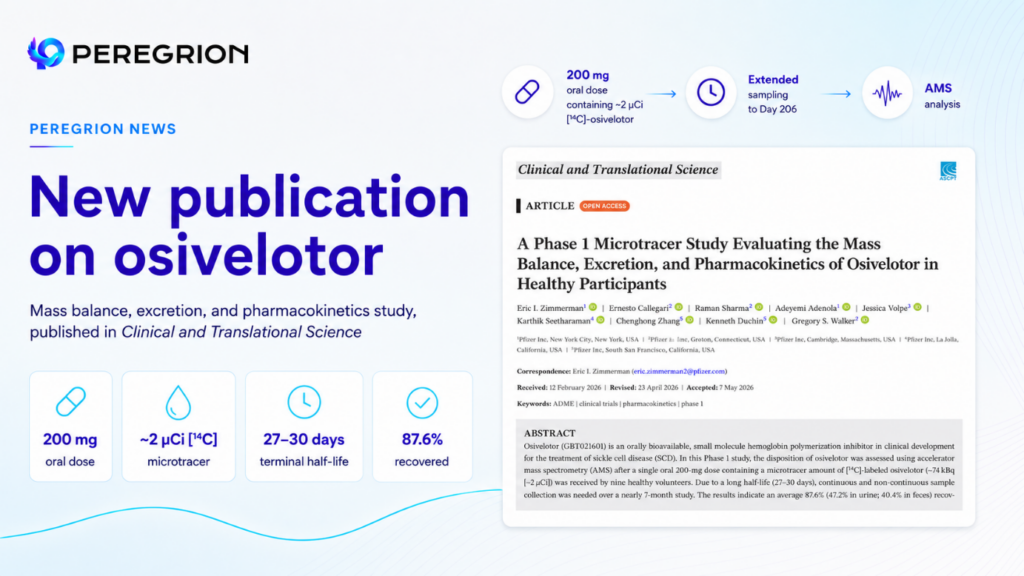
New publication on a long-duration microtracer ADME study of osivelotor
A newly published Phase 1 study shows how microtracer dosing and AMS enabled the characterisation of osivelotor’s mass balance and…
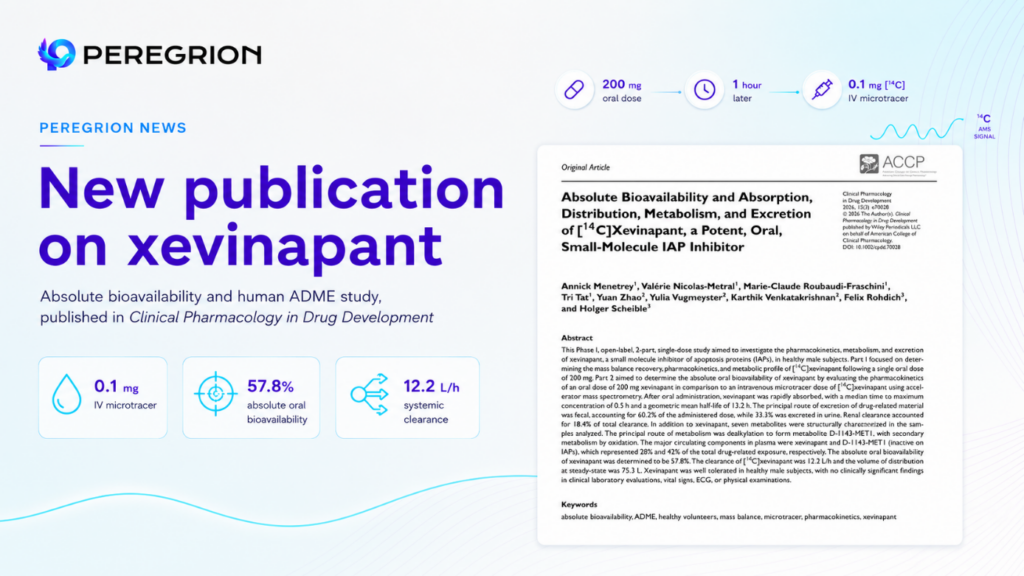
New publication on xevinapant absolute bioavailability and human ADME
A Phase 1 study on the absolute bioavailability, pharmacokinetics, metabolism and excretion of xevinapant has been published open access in…
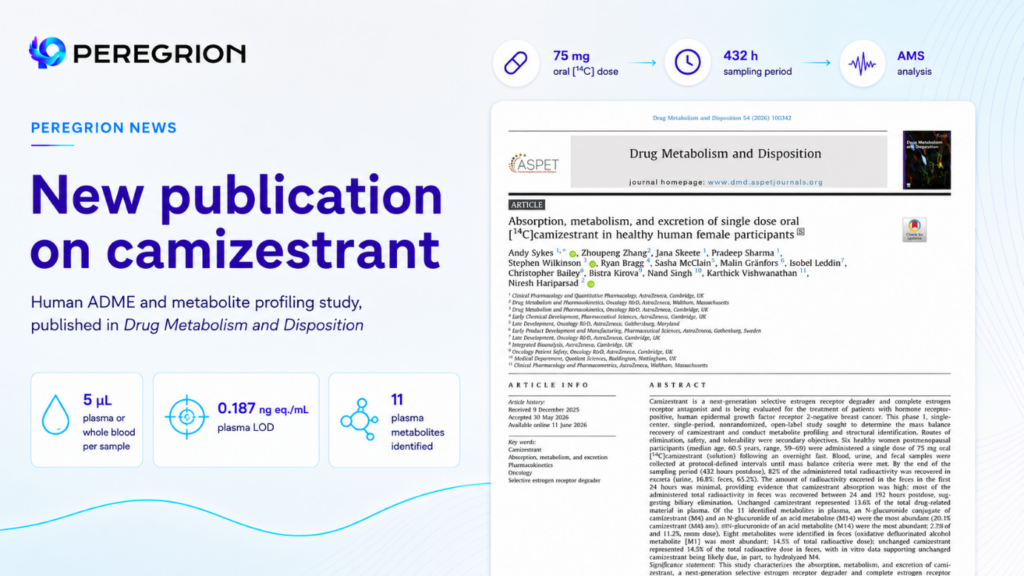
New publication on the human ADME and metabolite profile of camizestrant
A newly published Phase 1 study shows how AMS enabled total-radioactivity analysis from 5 µL samples and detailed metabolite profiling…
Support
FAQs
Frequently asked questions about AMS enabled microtracer studies
How long does it take from kick-off to final report?
Method qualification is not required for TRA analysis, meaning that your samples can be analyzed without pre-work. The time from sample receipt to analysis results is only 48 hours for discharge studies. Before the program kick-off, we will agree on the proposal including study plan and contracting. Contracting generally takes 1-2 months. Clients may request an audit before study initiation, which may take 1-2 months for planning. Total lead time from first contact to study start generally takes 6 months to a year and is largely determined by the start of the clinical study, not by Peregrion.
Why are early insights on parent drug and human metabolites important?
To enable a complete safety and efficacy assessment, it is important to know to what extent patients are exposed to the drug itself but also to drug derived metabolites. For every metabolite might have toxicological or pharmacological implications by itself. Only at the moment that we know that all metabolites are accounted for in humans, it can be assessed whether these metabolites are also present the animals that were used for safety and efficacy assessments.
Is microtracer radiolabeling a requirement for human mass balance studies via AMS?
Studies with AMS technology do not require microtracer radiolabels. Studies can be performed for drug products with low (microtracer) and high (conventional) radioactivity. The technology detects 14C labeled material and has the sensitivity to detect very low doses of radioactivity of 1 µCi and less in contrast to the conventional LSC method. LSC can only be used for high radioactive levels of 100 µCi and more.
Can animal dosimetry studies be waived with microtracer studies?
In a mass balance and metabolite profiling study, typically 1 µCi of the 14C-labeled drug is dosed orally at or around therapeutic level, and plasma and excreta are collected until >90% is excreted. The low 1 µCi radioactive dose does not require a-priori animal dosimetry studies. This saves time and money at a stage where the chances of successful development are still relatively unknown.
At a later stage, to prepare for NDA or MAA filing, animal dosimetry studies may still be required by the regulatory authorities. This depends on the type of drug, the disease indication and bioavailability. By that time you are reasonably certain about the success chances of the drug.
AMS technology is applicable for drugs that are in development for sensitive populations, why?
Due to its ultra-high sensitivity, AMS technology can be applied for drug products with minor levels of radioactivity that are in the low µCi range. This range is classified as ICRP Class I, meaning that studies in humans can be performed as early as Phase 0. The exposure during a 40 minute flight from Amsterdam to London is already the equivalent of one microtracer study; 1 µCi.
Furthermore, AMS has an LLOQ of 1-10 mBq/ml, which is 500-10,000x lower than LSC, and therefore AMS can measure drugs that are intended for administration at very low dose levels, for instance, for specific sub-populations.
What are the combined advantages of microtracer studies in clinical development?
Overall, the microtracer-based mass balance, metabolite profiling and absolute bioavailability studies in early clinical developments give an enormous enrichment of the data package available at early-stage without the need for separate studies to determine human ADME data. The data richness allows better study designs for follow up clinical studies, it allows earlier assessment and risk mitigation strategies for unexpected human unique metabolites, and it eliminates the need to conduct radioactive animal mass balance/metabolite profiling studies, where many animals, and much time and money are being spent on non-relevant animal metabolites.
Why is 14C labeling required for safety studies?
Incorporating radioactivity in the drug molecule is needed to ascertain that all metabolites will be found in the systemic circulation. Since virtually all drugs contain carbon, the highest scientific standard practice is to synthesize the drug with incorporation of radioactive carbon-14, and to dose this radioactive material to a small number of healthy participants or patients in a hADME study. Samples from excreta and blood or plasma can be analyzed to trace the drug and its metabolites. Analysis via AMS is up to 10,000-fold more sensitive than classical methods, for instance Liquid Scintillation Counting (LSC) and therefore very small amounts of radioactivity are sufficient.
Is human ADME data that is generated with microtracer studies acceptable for regulatory submissions?
The answer is ‘Yes’. We deliver data to our clients to support their regulatory submissions with regulatory-required or requested data such as human metabolism, routes of excretion, absolute bioavailability, and fraction absorbed. The FDA guideline on Safety Testing of Drug Metabolites Guidance for Industry (CDER) March 2020 Pharmacology/Toxicology recommends performing human in vivo metabolic evaluation as early as possible. The level of radioactivity in a microtracer study is only 0.1-1µCi. Conventional studies generally apply 100µCi. Due to the 100-fold lower radioactivity levels, ethical committees approve the use of 14C microtracers in early-stage clinical development.
What is a microdosing study in the context of a microtracer study?
A microdosing study includes a very low dose of the drug product (e.g. 100 µg) with a 14C microtracer. Due to the low dose (considered as an impurity) there is no toxicological concern and only a limited pre-clinical package is required to conduct such a study. This comes with the advantage that fewer lab animals are needed. Multiple drugs can be administered in the same study in parallel groups to aid in PK based candidate selection. A typical microdosing study consists of approximately 6 volunteers per drug. The microdose can be administered via any route, e.g. oral or intravenous.
Which data can be generated with Peregrion’s AMS-enabled studies?
- Absolute bioavailability data
- PK profile (for parent drug and known metabolites)
- Metabolite profile including metabolite identification
- Mass balance data
- Routes of excretion
- Information on the first pass effect
- Fraction absorbed
- Volume of distribution
What type of excreta are used in radiolabeled studies?
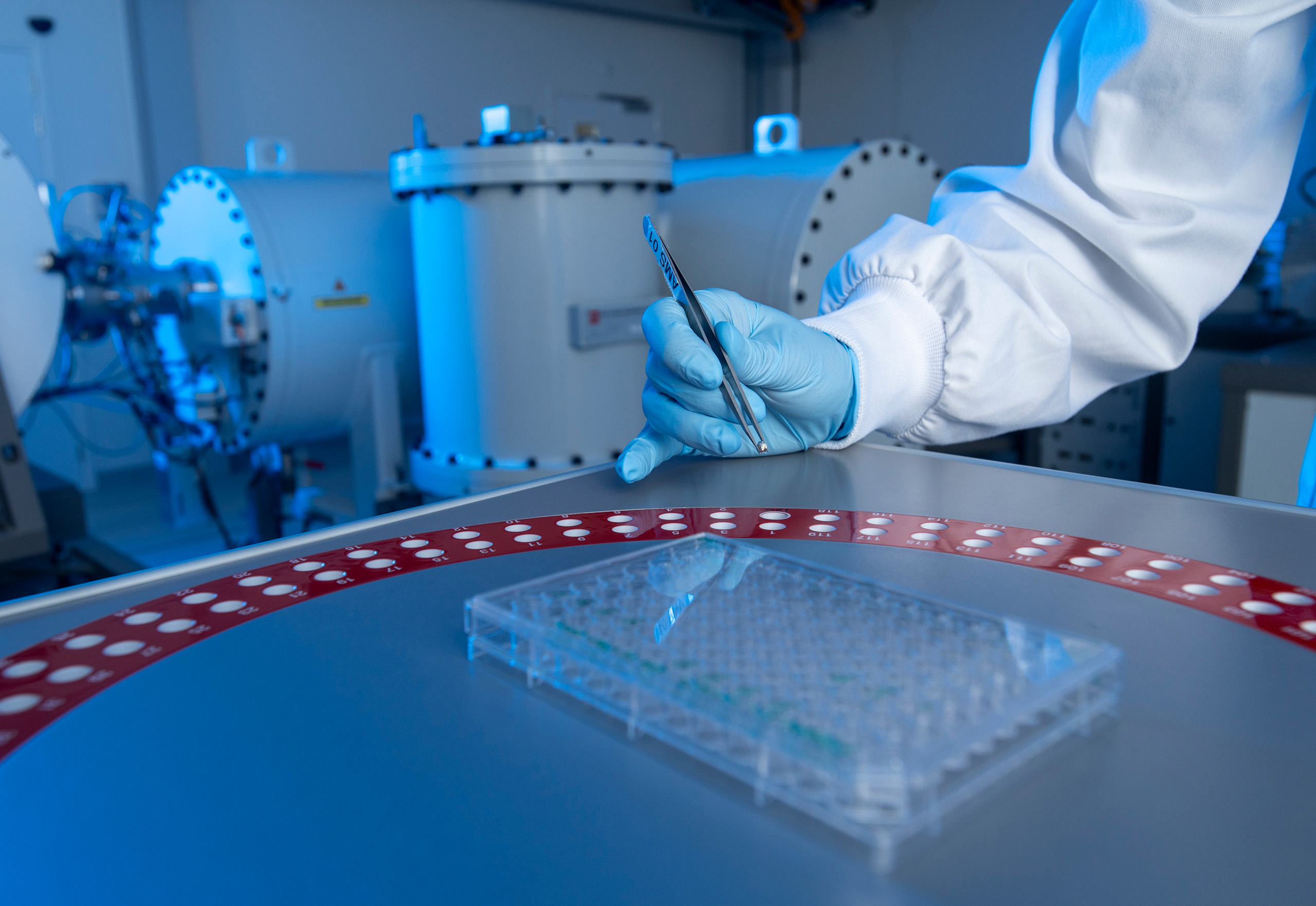
Total radioactivity measurements are done with human plasma, urine, whole blood, feces, exhaled air, bile and vomit. Very low sample volumes are required, i.e. 5 uL of plasma for a total radioactivity analysis and 50 uL of plasma for the generation of PK data or metabolite profling data. Samples are introduced via an automated sample combustion device that generates CO2, which is directed to the AMS via an interface. A single sample is completed in less than 10 minutes. The speed of the analysis supports discharge studies from a clinical site. You will receive the study results within 48 hours after sample receipt.
How do I start a microtracer study with Peregrion?
That’s easy. Contact us via the Contact Page on the website or reach out to your existing contact person at Peregrion. After initial exploratory conversations, we can arrange a CDA to freely talk about the project and your needs, and suggested steps forward. Our scientists will be involved at an early-stage to develop optimal study designs. After submission and approval of our proposal we will agree on a Study Agreement or Master Services Agreement. Your dedicated Project Manager will then guide you through the practicalities of getting started. When there is clarity on the dosing date(s) we will reserve time slots in our facility. You can contact us any time, we are happy to help.